Abstract · This article provides a detailed technical examination of the Cold Chain Transport Temperature Data Logger, exploring its operational principles, sensor technologies, data reporting mechanisms, and regulatory compliance frameworks. The discussion covers key technical specifications, certification requirements, and application considerations drawn from established industry practices.
01. Sensor Technology and Measurement Performance
The Cold Chain Transport Temperature Data Logger employs precision temperature sensing elements to ensure accurate measurement across a defined operating range. The PT1000 platinum resistance temperature sensor is a common choice for ultra-low temperature applications, offering high accuracy and stability[citation:1].
The measurement performance of these sensors varies based on the sensor type and operating range. For PT1000 sensors, accuracy specifications are typically stated as ±0.7 °C from -85 to -30 °C and ±0.5 °C from -30 to +70 °C[citation:1]. Alternative sensor types, such as RTD probes used in cellular loggers, may achieve accuracies of ±0.3 °C under controlled conditions, with resolution of 0.1 °C across the measurement range[citation:7].
-85 to +70 °C range
-196 to +150 °C range
-35 to +70 °C range
02. Data Storage and Reporting Capabilities
Up to 40,000 readings (testo 184 T3) or 32,000 readings (MSR85) [citation:1][citation:9]
Selectable from 1 minute to 24 hours [citation:1][citation:9]
Automatic PDF and CSV generation [citation:1][citation:5]
USB-C (MSR85) or USB (testo 184 T3) [citation:1][citation:9]
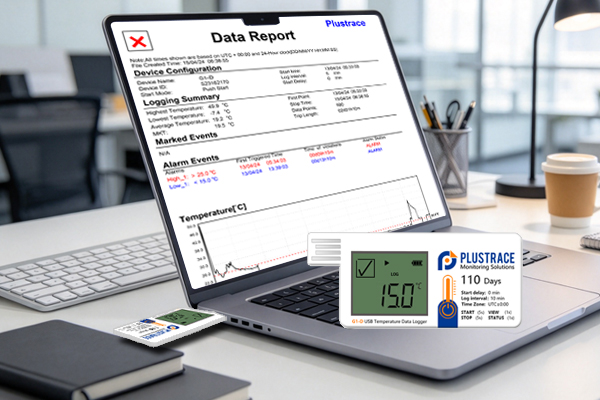
The Cold Chain Transport Temperature Data Logger is designed to automatically generate tamper-proof reports upon connection to a PC. This feature eliminates manual data entry and reduces the risk of documentation errors[citation:1]. The PDF reports typically include measurement tables, graphs, and summaries of statistical data such as minimum, maximum, and average values[citation:6].
03. Regulatory Standards and Compliance Frameworks
A Cold Chain Transport Temperature Data Logger must meet specific certification standards to be accepted in regulated industries. These certifications provide assurance of the device's performance, reliability, and suitability for monitoring critical shipments[citation:1][citation:6].
| Standard | Application | Key Requirement |
|---|---|---|
| EN 12830 | Food and pharmaceutical logistics | Certification for refrigerated and frozen transport [citation:1][citation:9] |
| FDA 21 CFR Part 11 | Pharmaceutical manufacturing and transport | Tamper-proof electronic records and signatures [citation:1][citation:5] |
| HACCP International | Food safety management | Certification for food quality assurance [citation:9] |
| IATA DGR | Air transport of dangerous goods | Safe for transport, no special marking required [citation:5] |
Based on certification data from multiple logger manufacturers [citation:1][citation:5][citation:6].
The EN 12830 standard is particularly important for food and pharmaceutical logistics, as it validates the logger's suitability for monitoring refrigerated and deep-frozen goods[citation:9]. Many manufacturers provide a five-point calibration certificate with each device to demonstrate traceability to national standards[citation:1][citation:6].
04. Battery Life and Power Management Systems
The operational lifespan of the Cold Chain Transport Temperature Data Logger is determined by its battery life, which varies based on device type, logging interval, and environmental conditions.
- USB loggers: Battery life up to 500 days at a 15-minute logging interval (e.g., testo 184 T3, testo 174 T) [citation:9][citation:11].
- Ultra-low temperature loggers: Approximately 100 days at a 10-minute logging interval (MSR85) [citation:6].
- Cellular loggers: ≥ 3 months at 30-minute upload intervals with LBS positioning, shorter with GPS active [citation:7].
Reusable loggers such as the MSR85 feature replaceable batteries, allowing the device to be reused across multiple shipments and extending its operational life[citation:1][citation:6]. This design approach reduces waste and supports sustainability goals in cold chain logistics.
05. Reusable vs. Single-Use Design Architectures
The Cold Chain Transport Temperature Data Logger is available in two primary design categories, each with distinct operational characteristics:
Reusable Loggers
- Replaceable batteries, allowing multiple uses [citation:1].
- Configuration via software tool to set alarm limits, intervals, and time zones [citation:5].
- Available in ultra-low temperature variants (down to -85 °C) for dry ice shipments [citation:1].
- Automatic generation of tamper-proof PDF and CSV reports [citation:6].
Single-Use Loggers
- Pre-configured for immediate use; no configuration required.
- Designed for one-time use; disposed after shipment [citation:8].
- Integrated display or LED indicators for immediate alert status [citation:9].
- Available with real-time tracking and cellular connectivity [citation:8].
The choice between reusable and single-use architectures depends on operational factors such as shipment volume, value of goods, and the need for real-time monitoring. Reusable loggers offer the benefit of lower per-trip cost over extended use, while single-use loggers provide simplicity and zero-maintenance operation.
06. Application Domains and Industry Use Cases
The Cold Chain Transport Temperature Data Logger is employed across a broad range of industries where temperature control is critical. Key application domains include:
- Pharmaceutical Logistics: Monitoring of vaccines, biological samples, tissues, and enzymes requiring secure cold chain down to -85 °C [citation:1].
- Food Transport: Tracking temperature of refrigerated and frozen foods, ensuring compliance with HACCP and EN 12830 standards [citation:9].
- Flower and Produce Transport: Temperature monitoring of cut flowers and green plants during international shipment [citation:9].
- Clinical Research: Monitoring of temperature-sensitive samples and reagents during transport between research facilities [citation:5].
- Healthcare Supply Chain: Tracking temperature of medical devices and diagnostic materials [citation:7].
Frequently Asked Questions
Product specifications and certifications may vary by model. Always consult the manufacturer's documentation for your specific application requirements.